


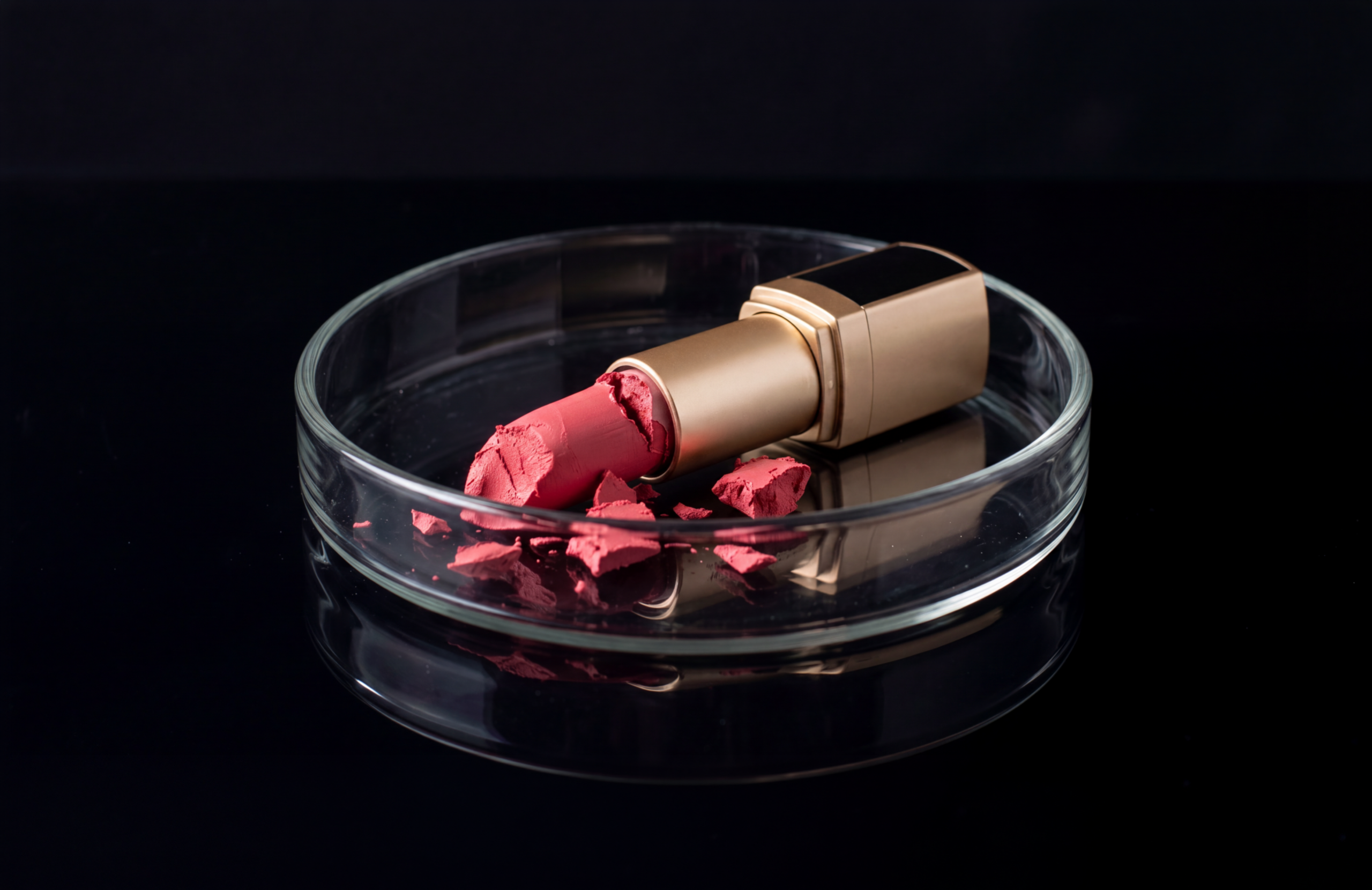
Copper Peptide Serums: Why More Actives Rarely Means Better Results
Elvira Trat - COO & Sales, Trat Development
Copper peptides are among the most thoroughly researched ingredients in modern skincare. But they're not a trendy accessory that makes a product better the more you add. A look at the peptide family, realistic expectations – and a real request from our day-to-day work.
- August 2026
The Short Version
Copper peptides (GHK-Cu / Copper Tripeptide-1) are one member of a larger peptide family – and every peptide has a different job.
Their effect is well documented, but gradual. A serum doesn't replace a professional in-clinic treatment – it does something different: daily, cumulative care.
And the effect doesn't increase the more actives you add. Often, the opposite is true.
One Ingredient from a Whole Family
Peptides are short chains of amino acids that act as messengers in the skin. "Peptide" isn't a single ingredient, but an entire family – and the groups have very different roles:
The Peptide Family in Cosmetics
Signal peptides
Give the skin "building instructions" – for example, to produce more collagen and elastin.
Examples: Palmitoyl Pentapeptide-4 (known as Matrixyl), Palmitoyl Tripeptide-1
Carrier peptides
Transport trace elements such as copper to where enzymes need them.
Example: Copper Tripeptide-1 (GHK-Cu)
Neurotransmitter-inhibiting peptides
Dampen the muscle signals that cause expression lines – often marketed as "Botox-like."
Examples: Acetyl Hexapeptide-8 (Argireline), Dipeptide Diaminobutyroyl Benzylamide Diacetate (Syn-Ake)
Enzyme-inhibiting peptides
Slow down enzymes that break down the skin matrix, helping protect existing structures.
Examples: certain soy and rice peptides
GHK-Cu – listed in the INCI as Copper Tripeptide-1 – is a particularly versatile member of the family: it acts as both a signal peptide and a carrier peptide. It's a tripeptide naturally found in the body, bound to a copper ion, and its concentration decreases with age. Once you understand this diversity, one thing becomes clear: the goal isn't to combine as many peptides as possible, but to use the right one in a targeted way.
What a Copper Peptide Can Really Do
The question I hear most often in sales isn't "How does it work?" but "At what concentration will I see results fast?" Behind it is an understandable expectation – more active, faster results. But that's not how skin works.
The science behind it is real: with more than four decades of research, GHK-Cu is one of the most studied peptides, and in one widely cited study, it stimulated collagen production more than retinoic acid. Still, an honest comparison is worth making. I'm in my late 40s myself, and I know the visible, sometimes dramatic effect that professional treatments can have. RF microneedling, for example, delivers a strong, immediately noticeable stimulus because it works intensively and precisely in the deeper layers of the skin. A serum can't – and shouldn't – replace that.
What a well-formulated copper peptide serum does instead is something different – and often more valuable in everyday life: it works quietly and continuously. With consistent use over weeks and months, it supports skin hydration, firmness, and a smoother-looking complexion – day after day, not in a single session.
It's the difference between an intense training session and daily movement. Both have their place – one sustains what the other sets in motion.
That's exactly why concentration is the wrong question. Results aren't determined by "as high as possible," but by a stable formulation and consistent use. A copper peptide at a cosmetically sensible dose that reliably reaches the skin does more than an overdosed one that doesn't stay stable in the jar.
More Isn't More
Because the ingredient is so popular right now, it often gets added to formulas that are already overloaded with actives. One example from our day-to-day work: a young brand asked for a copper peptide serum – and in the same product, also wanted PDRN, a second peptide complex, niacinamide, high-dose hyaluronic acid, polyglutamic acid, panthenol, and encapsulation. Plus an instantly visible effect and a silky texture.
The thinking is understandable: more actives = more protection, higher concentration = faster results. But skin is a living ecosystem; the same ingredient behaves differently depending on its environment, amount, and formulation. Too many actives compete for space and stability, can weaken each other – GHK-Cu, for example, doesn't play well with the highly acidic environment of vitamin C – and increase the risk of irritation without boosting efficacy.
The most effective formula is often the one that knows when to stop.
In this case, that's exactly what we recommended. The brand then deliberately chose a focused copper peptide serum and moved the other actives to a later product stage. A coherent, stable product instead of an overloaded wish list – and in the end, the more successful one.
What You Can Claim – In Brief
In the EU, cosmetic claims must be truthful, substantiated, and not misleading under Regulations (EC) No 1223/2009 and (EU) No 655/2013. For copper peptides, this mainly means two things: medical claims are off-limits, and you can't promise an overnight miracle just because an ingredient is popular. In the US, the FDA draws a similar line: claims that suggest a product treats or heals the body make it a drug rather than a cosmetic.
Substantiated & appearance-based
"for visibly smoother, firmer-looking skin"
"supports the skin barrier"
"supports the skin barrier"
Not permitted
"promotes wound healing"
"results like an in-clinic treatment"
"results like an in-clinic treatment"
For guidance only, not legal advice: whether a claim is permitted depends on the individual case and the available evidence. Every claim must be substantiated in the Product Information File (PIF) and reviewed with the safety assessor.
What This Means for Your Brand
A copper peptide serum can be a strong product – when three things come together: a focused formula that keeps this sensitive active stable, manufacturing that delivers it consistently, and claims you can actually back up. With us, all three come from a single source. So your brand doesn't get a product that promises everything – but one that works.
Frequently Asked Questions
A complex of a tripeptide naturally found in the body and a copper ion. In cosmetics, it acts as a signal and carrier peptide, and studies have shown that it stimulates the skin's production of collagen and elastin.
Initial improvements in how the skin feels often appear after a few weeks; visible effects on firmness and fine lines usually take two to three months of consistent use. It's not the concentration that matters, but stability and regular use.
No – they do different things. A professional treatment delivers an intense stimulus; the serum provides the daily, cumulative care that maintains and extends the results.
No. Too many actives compete for stability, can weaken each other, and increase the risk of irritation. A focused formula is usually more effective than an overloaded one.
No – that's a medical claim and not permitted for cosmetics, even if raw material data sheets mention it. Appearance-based, substantiated claims, on the other hand, are possible.